Վերադարձ · veradardz.com
{{ days }} days since exile
RU HY EN
Վերադարձ Movement for the right of Artsakh Armenians to return
For the right to return · for Artsakh's self-determination

The right to return is not a request — it is a norm of international law

In September 2023, more than 100,000 Armenians were forcibly expelled from Artsakh. We are working for their collective, safe and dignified return, for the protection of Christian heritage, and for the release of prisoners held in Baku.

Time is passing
{{ days }}
days since the expulsion
19 September 2023
100 000+ expelled residents of Artsakh 9 mo. blockade of the Lachin Corridor ICJ order on the right to return, 17 Nov 2023
01 Chronicle of loss

What happened in Artsakh

Nine months of blockade and a single day of military offensive ended a centuries-old Armenian presence in Nagorno-Karabakh.

Dec 2022 — Sep 2023

Blockade of the Lachin Corridor

The only road linking Artsakh to Armenia was closed for almost nine months. Around 120,000 people faced shortages of food, fuel and medicine.

19–20 September 2023

Military offensive

A large-scale operation against Artsakh forced its capitulation within a single day. Thousands sheltered at Stepanakert airport and in nearby villages.

late September 2023

Exodus of the population

Within days almost the entire population — more than 100,000 people — left Artsakh. Towns and villages emptied; monasteries and cemeteries were left unprotected.

02 Statements

Statements of the movement

Voices of the members of the Veradardz movement.

Voice of a movement member

On the independence of Artsakh and reunification with Armenia

Taking into account the current situation in the Republic of Armenia, and seeking a change of the current authorities and to prevent the country from being drawn into geopolitical projects alien to it, I consider it necessary to make the following clarification.

I believe that the declaration of Artsakh's independence resulted from external pressure and was, in my view, a strategic mistake by the leadership that ran counter to the principles of the Declaration of Independence of the Republic of Armenia. For years this allowed the adversary to portray the Republic of Armenia as an «occupier» and to justify the military seizure of Artsakh's territory.

Our movement supports the reunification of Artsakh with Armenia: the present Republic of Armenia, as the lawful successor to the First Republic, should have rejected the decision by which, in 1921, Artsakh was unlawfully placed under the administrative jurisdiction of Soviet Azerbaijan.

I am convinced that a final resolution of the Artsakh question is inseparable from a comprehensive resolution of the Armenian Question — on the legal and treaty basis of the League of Nations' draft proposal of 24 February 1920 on the delimitation of borders, the 1920 Treaty of Sèvres, and the arbitral award of Woodrow Wilson of 22 November 1920.

While remaining committed to the legal and political defence of the rights of compatriots forcibly displaced from Artsakh, at this stage I advocate their return to their homeland under international security guarantees.

I call on all political forces to reconsider their approaches to the Artsakh problem in light of regional realities and the norms of international law. Only through joint efforts and a realistic approach can a just and sustainable solution be found.
Samvel Tumasyan · member of the Veradardz movement
D David Tumasyan member of the Veradardz movement

On the attacks against Artsakh Armenians

I strongly condemn the campaign of incitement, the stirring of hatred, and the division of the Armenian people, waged through social media and other public means against the Armenians of Artsakh.

The Armenians of Artsakh, like residents of other regions of Armenia, should feel at home in the Republic of Armenia. Under the Constitution they hold every right to express themselves freely and without hindrance and to defend the interests of the Armenian people and of Armenia, including through assemblies, demonstrations and pickets.

After the forced exodus from Artsakh, thousands of Armenians encountered systematic violations of their rights in Armenia. Displaced people have repeatedly reported unfounded refusals and lengthy delays in the issuance of Armenian passports, the non-recognition of previously issued documents, restricted access to public services, and being effectively deprived of the ability to fully exercise their civil and political rights. Those affected have repeatedly stated that such practices are discriminatory towards the Armenians of Artsakh and place them in an unequal position compared with other citizens of the Republic of Armenia.

We call on our compatriots to give a firm response to the information campaigns waged through bloggers and fake accounts and aimed at separating our Artsakh compatriots from the integrity of the Armenian people — both nationally and politically.

The movement affirms that the surrender of Artsakh was allowed through the acquiescence of the current administration, and that the Armenian people, as a single political whole, must make efforts towards the further political steps necessary for the return of Artsakh.

02 International law

Right to return

The return of a displaced population to its homeland is not a political concession but an established norm of international law. International consensus on Artsakh is growing.

«…the safe, unimpeded and speedy return of those who left Nagorno-Karabakh and wish to return».

International Court of Justice, order of 17 November 2023
ICJ
Provisional measures
The Court ordered that conditions be ensured for safe and unimpeded return.
EP
European Parliament resolutions
Calls to guarantee the right to return and international monitoring.
CH
Switzerland's initiative
A peace-forum platform to discuss the conditions for return.
FR·BE
Positions of France and Belgium
Parliamentary support for the rights of Artsakh's displaced population.
03 Historical and legal position

Artsakh: history and self-determination

The right of the people of Artsakh to self-determination rests on an unbroken historical and legal tradition — not on administrative borders imposed during the Soviet period.

The movement views modern statehood as continuous with the 1918–1920 Republic of Armenia and the international acts associated with it.

1918–1920

Republic of Armenia

Succession to the First Republic as the legal basis of the modern position on territory and borders.

10 August 1920

Treaty of Sèvres

The treaty referred the border dispute to the arbitration of US President Woodrow Wilson.

22 November 1920

Wilson's arbitration

The arbitral award defined the border between Armenia and Turkey; the movement invokes its legal force.

1921

Contesting the treaties

The Treaties of Moscow and Kars and the imposed Soviet administrative borders are contested as illegitimate.

24.02.1920

The report-proposal of the League of Nations Special Commission on the determination of the border is one of the key documents underpinning the movement's legal position.

07 Our programme

What we demand

01

Safe collective return under international guarantees

02

An international monitoring mission in Artsakh

03

Release of prisoners and hostages held in Baku

04

Protection of Armenian Christian and cultural heritage

05

Accountability through international courts and tribunals

04 Testimonies · memory and hope

Stories of displaced families

Behind every story is a family, a home and the right to return. Below are real testimonies of families from Artsakh, documented by international organisations and publications.

They lost their home three times — in 2020, 2022 and 2023. When the sky lit up with explosions on 19 September, the younger daughter was at school; as she fled, Mileta instinctively grabbed the family albums.

Mileta and her daughter Mane (13)
Martakert → Armenia
Based on MSF (Doctors Without Borders), 2024 →

«Every night I return to Stepanakert, and every morning I wake up in Echmiadzin.» Before leaving, Anahit said farewell at her elder son’s grave; in Artsakh the family used to make jingalov hats.

Anahit Ananyan and her family
Stepanakert → Echmiadzin
Based on Nationalia, 2025 →

They left as a family of five, leaving behind a home and a shop in Artsakh; to make room for the dog and cat they did not even take clothes.

Arpine Gasparyan, 37
Shushi → Abovyan
Based on Armenian Caritas →
05 Cultural heritage

Heritage at risk

The Armenian churches, monasteries and khachkars of Artsakh are part of the world’s Christian heritage. Without independent monitoring they face destruction and the rewriting of history.

We call for the international documentation and protection of these monuments and support access for independent experts and UNESCO.

Khachkars

Cross-stones are a unique Armenian monument inscribed on the UNESCO heritage list. They require documentation and protection.

Monasteries and churches

Gandzasar, Dadivank, Amaras and dozens of other shrines need conservation monitoring.

Arevakhach — symbol of eternity

The ancient Armenian symbol of eternity on temple walls — evidence of a continuous presence.

06 Freedom for the detained

Prisoners and hostages

Armenian prisoners and civilian hostages, including former Artsakh officials, are held in Baku. We demand their unconditional release and access for independent observers.

Support the demand for their release →
Detained officials
Former Artsakh officials held in Baku. We demand their release and access for independent observers.
held
Civilian hostages
Civilians held as hostages. We are pressing for their immediate release.
held
Prisoners of war
Armenian prisoners of war whose fate requires international oversight and return home.
held
08 Appeal

Sign the appeal on the right to return

We deliver signatures to parliamentarians and international organisations. The call: ensure the safe collective return of Artsakh’s Armenians under international guarantees.

{{ countLabel }}
signatures collected
goal
10 000

Add your signature

{{ petError }}
{{ petNote }}

Thank you, your signature has been counted

Share the appeal — it will gather more voices.

09 Targeted campaign

A letter to an MP or the Foreign Ministry

A ready-made template. Copy it, edit if you wish, and send it to your representative in parliament or to the ministry of foreign affairs.

appeal-template.txt
{{ letterText }}
11 Campaign materials

Download and share

Ready-made flyers and images in a single style. Print them, pass them to friends, or post them on social media — all free and without registration.

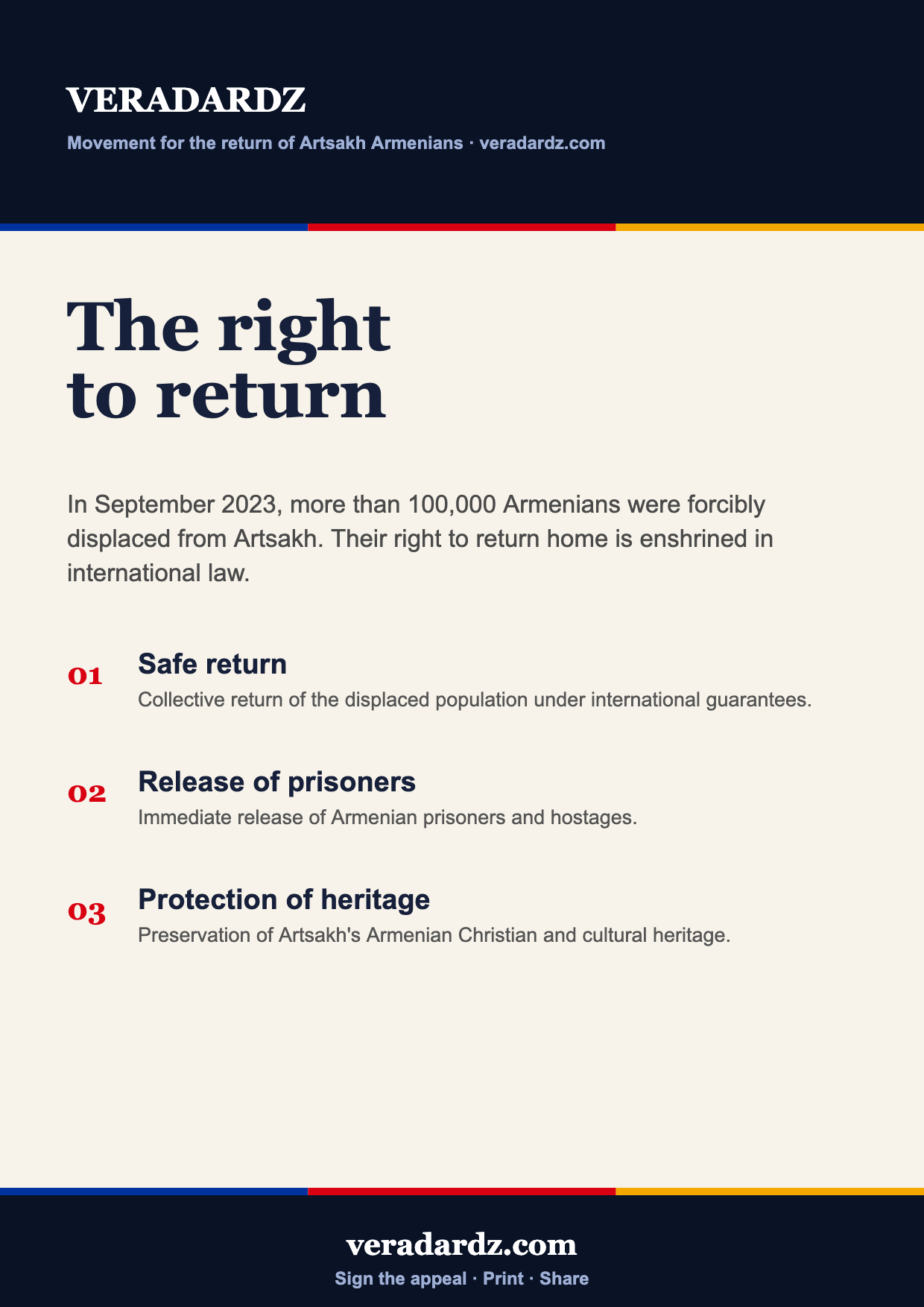
Flyer A4 «Right to return»
PRINT · A4

Flyer «Right to return»

A vertical flyer with three demands. Print at home and hand out to friends.

↓ Download PNG
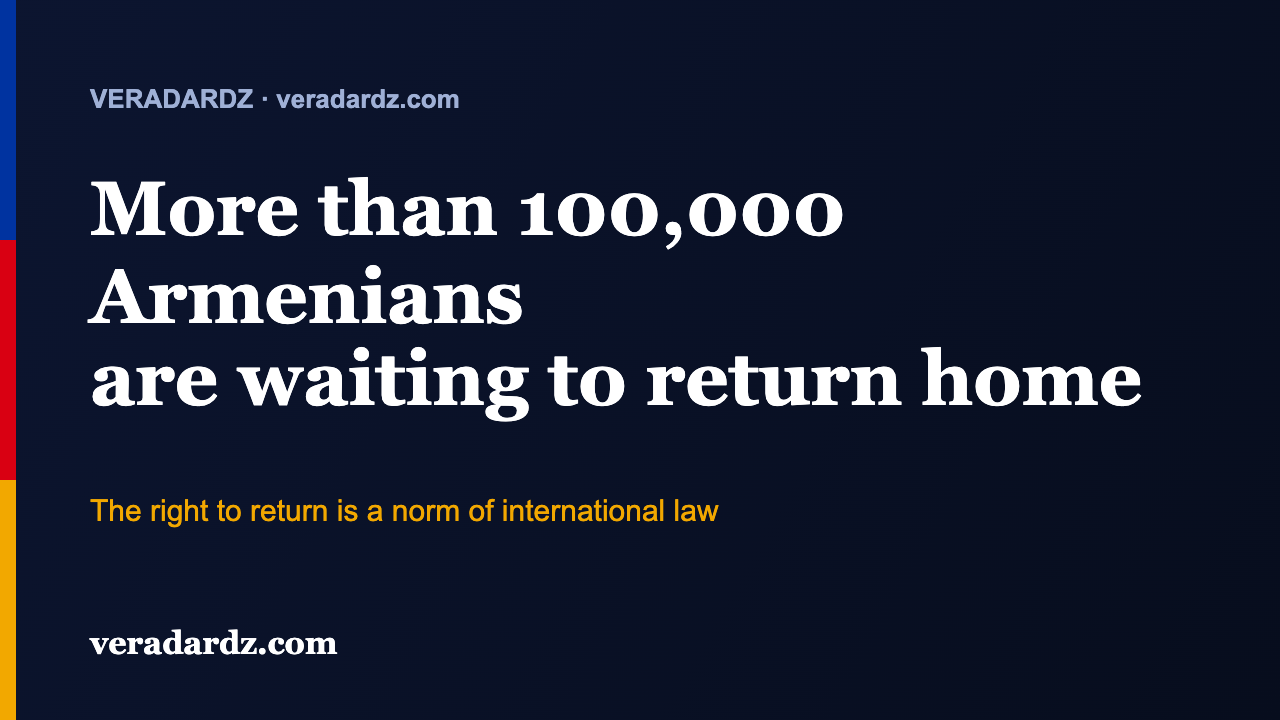
Poster «More than 100,000 Armenians»
COVER · 1280×720

Poster «More than 100,000 Armenians»

A horizontal cover for channel headers, events and posts.

↓ Download PNG
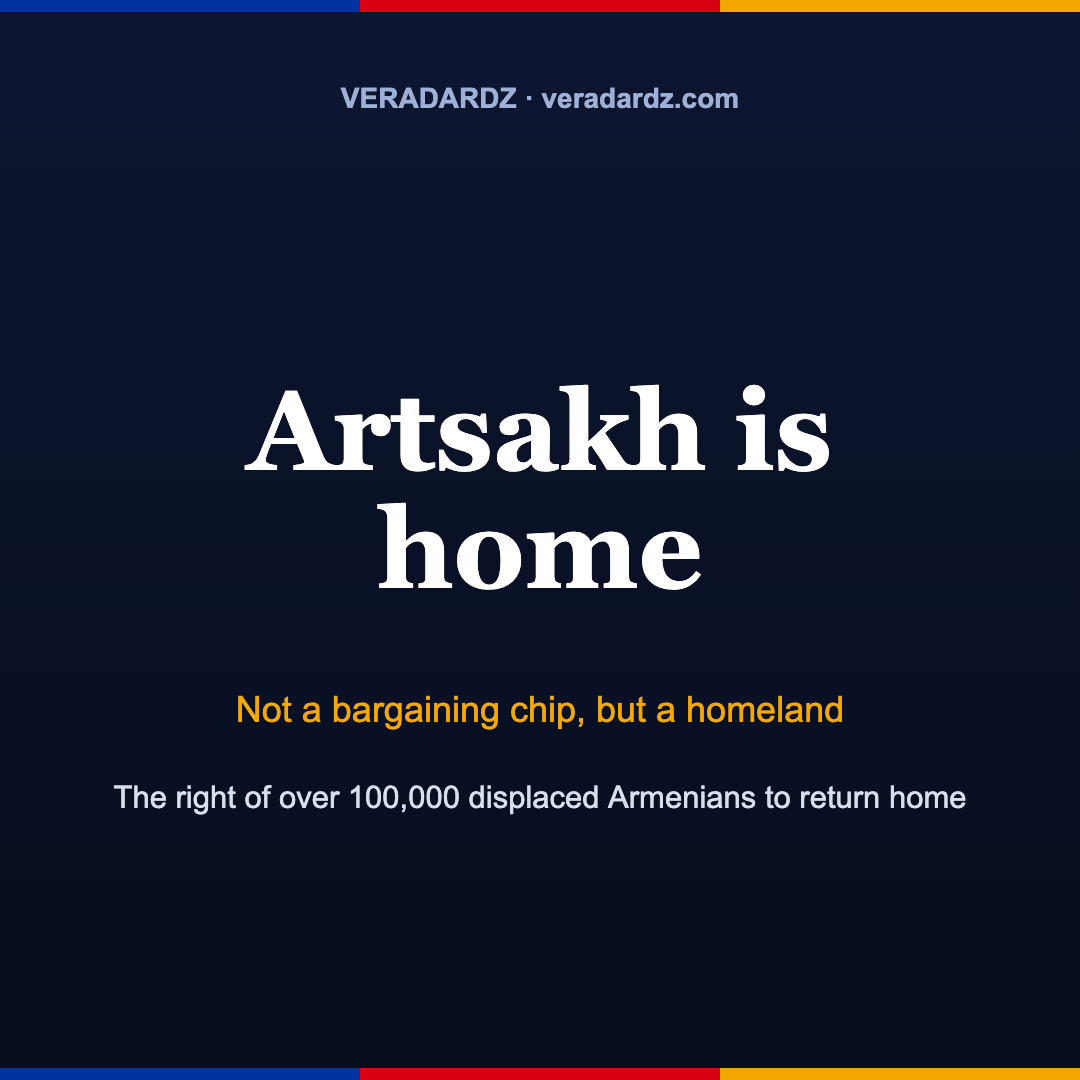
Square post «Artsakh is home»
POST · 1080×1080

Square post «Artsakh is home»

For posts on Telegram, Instagram and Facebook.

↓ Download PNG
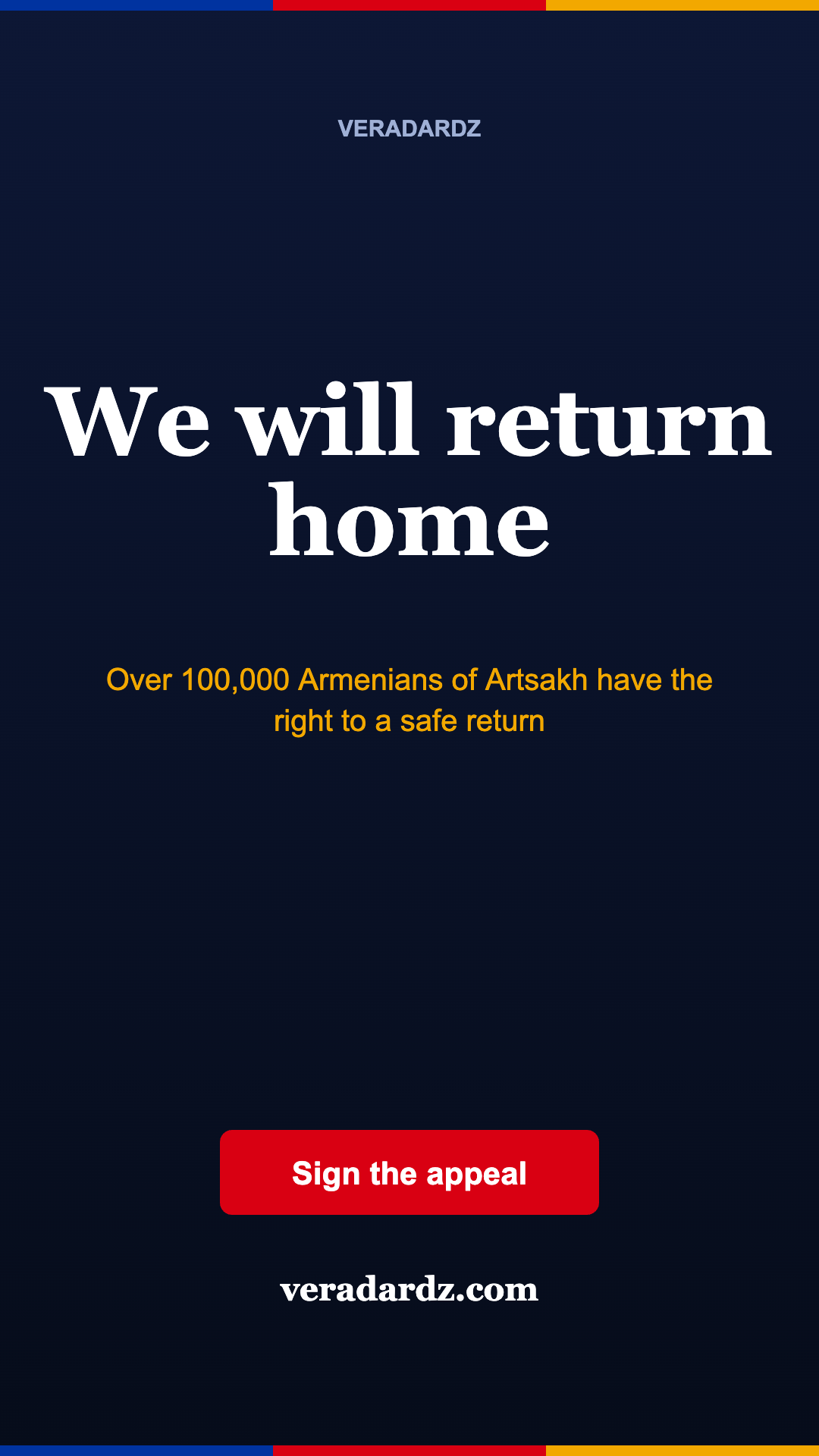
Story «We will return home»
STORIES · 1080×1920

Story «We will return home»

For Instagram stories and messenger statuses.

↓ Download PNG
!

How to use. Print the flyer on an ordinary printer (A4), put up the poster, or post the image on social media and messengers. The more people see it, the more visible our movement becomes.

12 Join

Contacts and feedback

Write to us if you want to join the movement, share a testimony, or propose cooperation.

@
Email
info@veradardz.com
TG
Telegram
@veradardz
{{ contactError }}
{{ contactNote }}

Message sent

Thank you. We will contact you if needed.